
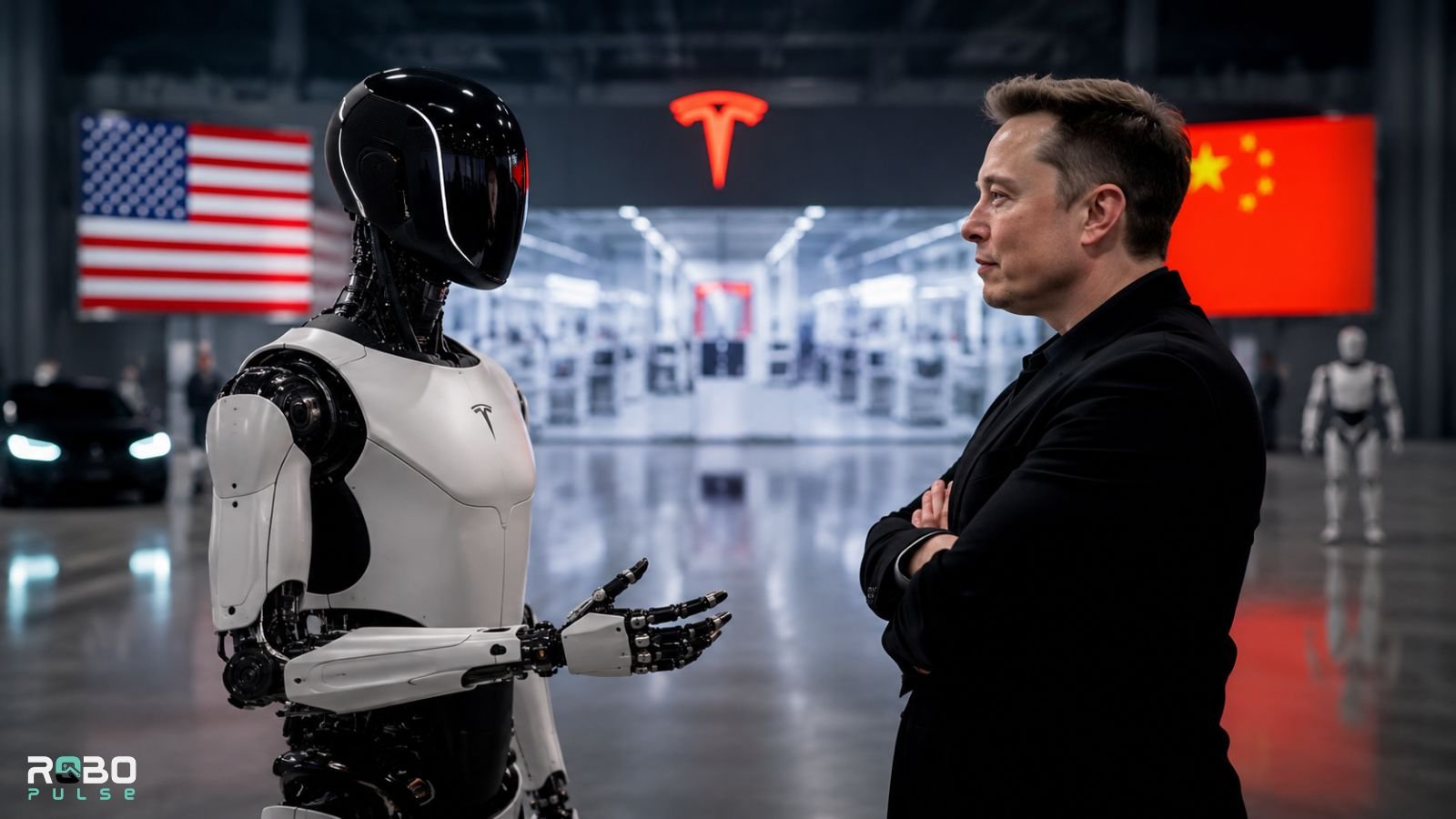
Elon Musk dropped a big claim on Tesla’s January earnings call. Optimus, he said, will become the biggest product in Tesla’s history. Bigger than the Model 3. Bigger than anything the company has shipped.
That line will win every headline this week. It’s not the part worth remembering.
A few minutes later, Musk said something rarer. He named China as the toughest competitor Tesla has ever faced in a product category. No hedging. No “we don’t really see competitors” deflection. Just a direct admission.
What Musk Actually Said About Optimus
Musk called Optimus “ten times bigger than the next biggest product ever made.” It’s a quote built for a headline, not a spec sheet.
Tesla is backing the ambition with real factory changes. The company tore down its original Model S and Model X assembly line at Fremont in just 46 days, clearing floor space for Optimus. Gen 3 hands hit production-ready status in February, and full-scale output on the converted line starts in late July or August.
Roughly 1,000 Optimus units already sit inside Tesla’s factories today. But don’t mistake presence for output. Musk himself said on the January call that none of them were doing “useful work” yet. They’re there to generate training data, not to build cars or robots at scale.
Why Musk’s China Comment Is the Real Story
Asked about competition, Musk skipped the usual founder move of downplaying rivals. He named a country, not a company.
“China will definitely be the toughest competition for Tesla,” he said, pointing to manufacturing scale and fast-improving domestic AI models as the reason.
That’s an unusual admission from an executive who normally frames Tesla as operating alone at the top. It also lines up with what China’s humanoid sector is already doing on the ground: companies there are further along turning robots into working retail staff than most Western programs.
China’s manufacturing edge isn’t hypothetical either. Suzhou Green Harmonic, a Chinese supplier, already holds close to a quarter of Tesla’s harmonic drive business and is targeting 60% of the global reducer market at prices well below Japanese suppliers. Tesla is sourcing a key Optimus component from the same country Musk just called his biggest threat.
Hands Decide This Race, Not Bodies
Musk claimed two areas where Tesla still leads: real-world AI and hand dexterity. He’s called hands the hardest engineering problem in the entire Optimus program, harder than Cybertruck.
The specs back that up. Gen 3 hands moved from 11 degrees of freedom to 22, packing 25 actuators into the forearm instead of the hand itself. That fight isn’t unique to Tesla. Every serious humanoid program is racing on the same metric, which is why degrees of freedom matter more to a robot’s real capability than payload numbers do.
Tesla also isn’t the only team wrestling with this problem using ex-Tesla talent. Milan Kovac, who ran Optimus until mid-2025, now leads robotics at Boston Dynamics under Hyundai.
Why the Admission Beats the Hype
Set against a slow, real R&D ramp at Fremont, “biggest product ever” is aspiration. Every major humanoid program has made some version of that claim, including Figure, Apollo, and Unitree.
A founder naming the exact country closing the gap on him is rarer, and more useful. It tells you where the market’s actually headed in 2026, not where Tesla wants it to go.
Readers who want the full spec breakdown can find it in RoboPulse’s Tesla Optimus Gen 3 review, and the compare tool puts it side by side with the rest of the field.
Related: 1X’s New Robot Hands Are Impressive. Its Sold-Out Factory Is the Bigger Story