

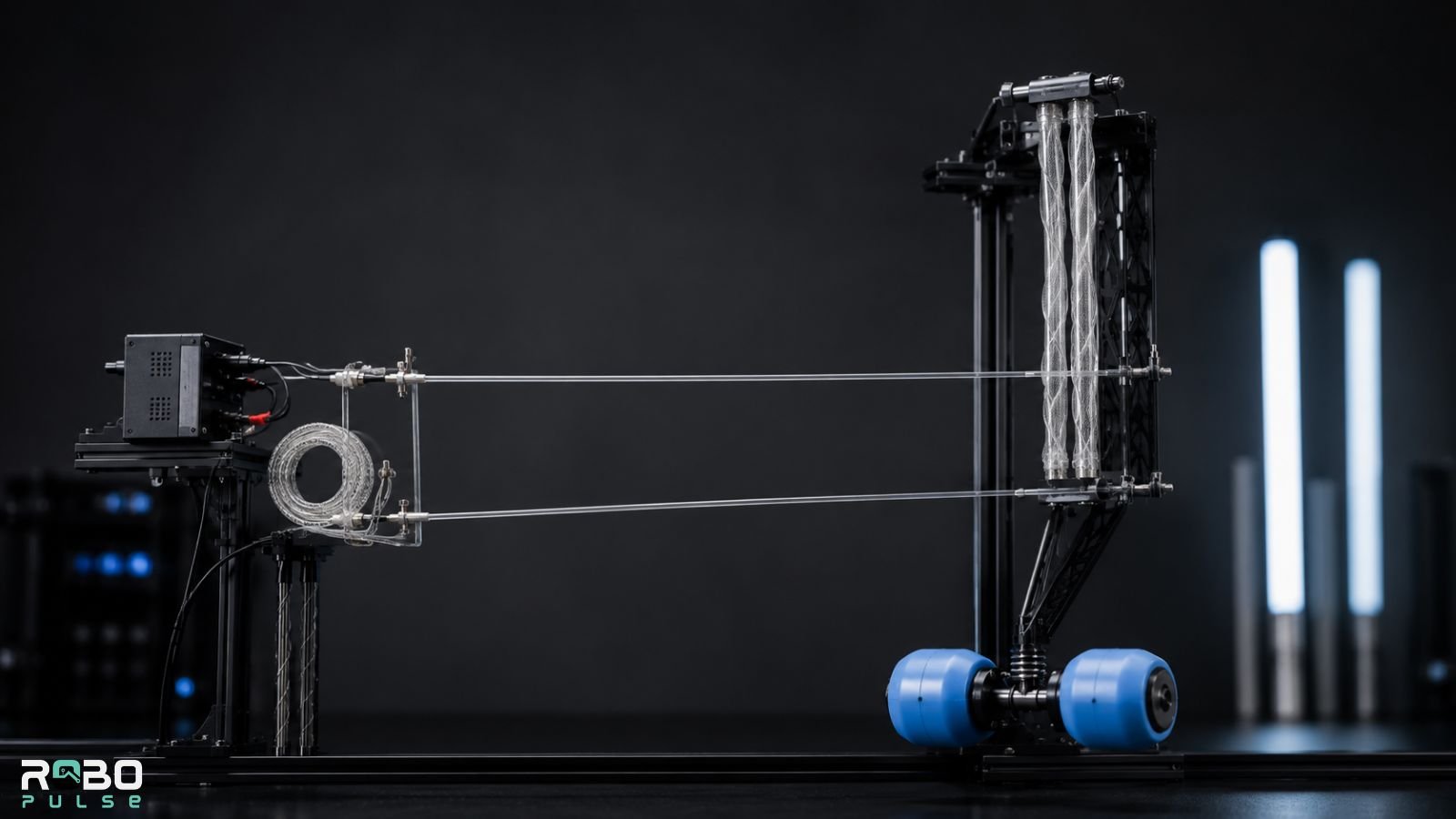
Fast Facts: Electrofluidic Fiber Muscles (EFMs)
- Built by: MIT Media Lab (Tangible Media group) and Politecnico di Bari
- Published in: Science Robotics
- Core innovation: Electrohydrodynamic (EHD) fiber pumps built directly into the muscle
- Fiber thickness: About 2 millimeters
- Power density: 50 watts per kilogram — matches human skeletal muscle
- Contraction strain: 20%
- Response time: 0.3 seconds
- Lifting demo: A gram-scale bundle lifted 4 kilograms
A Robotics Problem Nobody Solved Cleanly Until Now
Most robots move with servo motors. Motors spin. Muscles don’t. Every robotic arm on the market spends extra hardware just converting rotation into a straight pull, and that conversion costs weight, space, and precision.
MIT Media Lab PhD candidate Ozgun Kilic Afsar and Politecnico di Bari professor Vito Cacucciolo just published a fix. Their team built an artificial muscle fiber that contracts on its own, drives its own fluid, and needs no external pump, tank, or compressor. The full paper, “Electrofluidic fiber muscles,” appeared in Science Robotics this year, and MIT’s own writeup walks through how the team got there.
How the Fiber Pump Actually Works
Soft roboticists have used pressurized McKibben actuators for decades. You push air or fluid into a braided sleeve, it shortens, and it pulls. The catch: something external has to generate that pressure, and that something is usually loud, heavy equipment sitting outside the robot.
Afsar’s team replaced the external pump with a fiber-scale one. A thin tube lined with helical electrodes sits between two McKibben actuators. Apply voltage, and the tube injects charge directly into a dielectric fluid inside it. Those charges drag the fluid along with them — a process called electrohydrodynamic pumping. No pistons, no moving parts, and no noise.
Route that pressure into one actuator, and it contracts. Relax the other side, and it stretches. Anchor a pump between two fibers arranged this way — one flexing while the other extends — and you get a closed loop that never needs to vent to open air. Cacucciolo compares it directly to how a bicep and tricep trade off with every arm bend, a point Politecnico di Bari’s own coverage of the project drives home too.
The Real Breakthrough Was Solving Cavitation
Here’s the detail most coverage will skip: early versions of this system kept failing.
Run an EHD pump hard enough, and pressure at its inlet can drop below the fluid’s vapor pressure. Vapor bubbles form. The pump degrades. Eventually it stops working entirely. Engineers call this cavitation, and it’s the reason nobody had closed this loop before.
Afsar’s fix was to pre-pressurize the whole system before it ever ran — a “bias” pressure that keeps the inlet pressure above the vapor threshold at all times. Dial that bias pressure up, and the muscle responds faster but contracts less. Dial it down, and contraction strength climbs instead. The team can tune each fiber for the job it needs to do.
That single design decision is what let the system hit 50 watts per kilogram, a number that puts it in the same range as your own skeletal muscle.
What the Team Actually Built With It
Specs on paper mean little without demonstrators, so the team built several.
A fast lever configuration launched objects in 0.2 seconds. A stronger bundle — weighing only a few grams — lifted 4 kilograms, roughly 200 times its own mass. A woven biceps-triceps pair drove a full robotic arm through a bend, and stayed soft enough that a human could safely shake its hand.
That last point matters more than it sounds. Compliance is the entire reason exoskeletons and rehabilitation devices haven’t scaled the way humanoid platforms have — rigid actuators near skin are a safety liability, not a feature.
Why This Matters for the Humanoid Robotics Race
Right now, the humanoid field competes almost entirely on degrees of freedom and bipedal balance — the visible wins that show up in demo videos. Actuation itself has stayed conventional. Every major platform still leans on rotary motors and harmonic drives borrowed from industrial automation.
Fiber muscles attack that problem from a different angle: distribute the actuation along the limb instead of concentrating it at the joint. Herbert Shea, a soft-actuator researcher at École Polytechnique Fédérale de Lausanne who had no role in the work, told MIT that the paper delivers a complete system-level solution — the team characterized every component, built a predictive model, and backed it with working hardware instead of a single lab demo.
Where It Still Falls Short
None of this ships in a consumer robot next quarter. High-voltage electrodes running inside a fluid-filled fiber that wraps around a moving joint raise insulation and long-term durability questions that take years to close out. Bias pressure tuning also means every application needs its own calibration — there’s no universal setting that maximizes both speed and strength at once.
The European Research Council and the Media Lab’s sponsor consortium funded the work, and the team says the same fiber-pump principles apply to any fluid-driven robotic system, not just muscles. Expect exoskeleton and assistive-device builders to move first, with full humanoid integration further out. The MIT Media Lab project page has video of the untethered demos if you want to see the fibers actually move.