

The humanoid robot headlines keep coming. The actual money is moving somewhere quieter.
A new Interact Analysis report makes a case that most coverage is missing: while humanoid robots themselves remain in early deployment, the component suppliers feeding their development are already seeing volume orders. The first companies to profit from the humanoid boom may not be humanoid companies at all.
What the Numbers Say
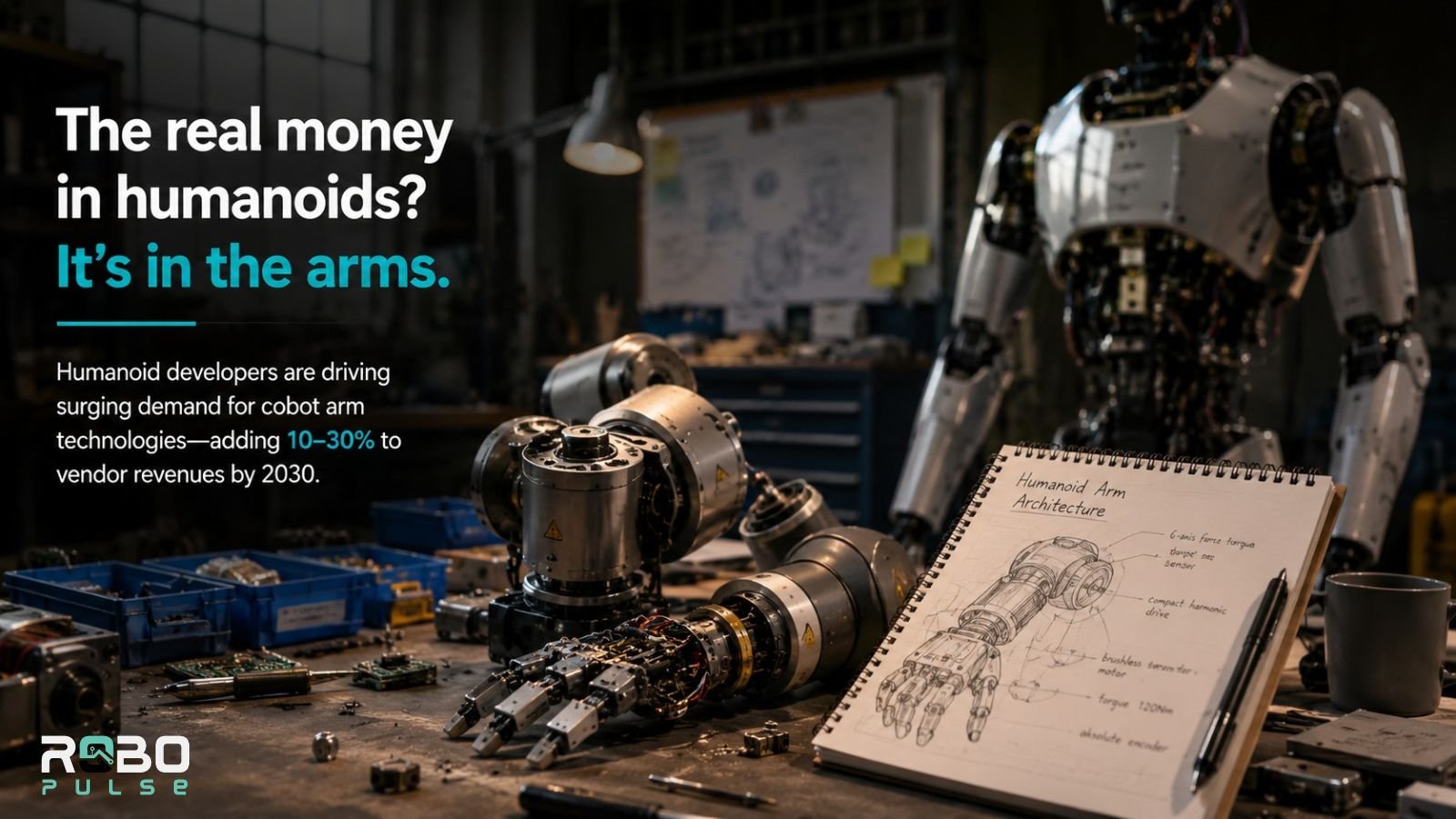
Interact Analysis projects humanoid robot revenue could reach roughly $15 billion by 2035, with commercialization accelerating meaningfully through the early 2030s. The downstream effect on collaborative robot vendors could arrive well ahead of that — potentially adding between 10% and 30% to cobot makers’ total revenues by 2030.
That gap is the real story. Component demand is scaling before humanoid deployments do. Actuators, servo systems, motion-control architecture, and robotic arm technologies are becoming the picks-and-shovels layer of an industry that hasn’t yet hit its stride. The vendors supplying that layer are collecting revenue now.
And crucially, these aren’t pilot orders. Humanoid developers are making volume purchases — a signal that hardware sourcing decisions have shifted from experimentation to supply chain commitment.
Why AI-First Startups Are Buying What They Didn’t Build
A significant share of the newer humanoid entrants are organizations built around AI — strong on foundation models and training pipelines, but without deep manufacturing roots or robotics hardware lineage. Building that stack from scratch is expensive and slow, so they’re sourcing it instead.
That means increasingly sourcing arm technologies, actuators, motion-control systems, and manufacturing expertise from the collaborative robotics ecosystem. Upper-body hardware from cobot vendors. Mobility bases from AGV and AMR suppliers. The result is a modular architecture where AI-first companies focus on the intelligence layer and established hardware makers supply the physical one.
It’s worth noting that the landscape is broader than any single archetype. Tesla brings automotive manufacturing experience. Agility Robotics emerged from robotics research. Several Chinese players come from automation and industrial backgrounds. But across the board, reliance on third-party hardware suppliers — rather than fully vertical builds — is becoming the dominant pattern.
For cobot vendors, this is a low-risk expansion. It doesn’t cannibalize existing industrial customers. It opens a secondary channel with buyers who need proven hardware fast.
China’s Supply Chain Advantage
Geography shapes who captures this demand first.
China currently possesses one of the most vertically integrated and scalable robotics supply chains in the world — spanning actuators, motors, harmonic reducers, batteries, and manufacturing capacity. That gives Chinese cobot manufacturers a meaningful head start if humanoid production ramps quickly. They can respond to volume orders at pace and price points that competitors in the U.S., Europe, and Japan will struggle to match in the near term.
The U.S. has a humanoid production capability. What it lacks is the same end-to-end industrial readiness. That gap doesn’t disqualify American vendors — but it does mean they’ll need time to close it before they can compete for the scale orders that matter.
What Comes Next
The humanoid industry is still in its early innings. Shipments remain small. Deployments are measured in pilots, not production lines. But component orders are already growing, and that sequencing matters: hardware suppliers are scaling before the humanoids themselves do.
That’s the pattern to watch. When component revenues move first, it usually means the larger deployment cycle is closer than the public timeline suggests.
The first wave of humanoid profits won’t look like humanoids at all. It’ll look like robot arms.