

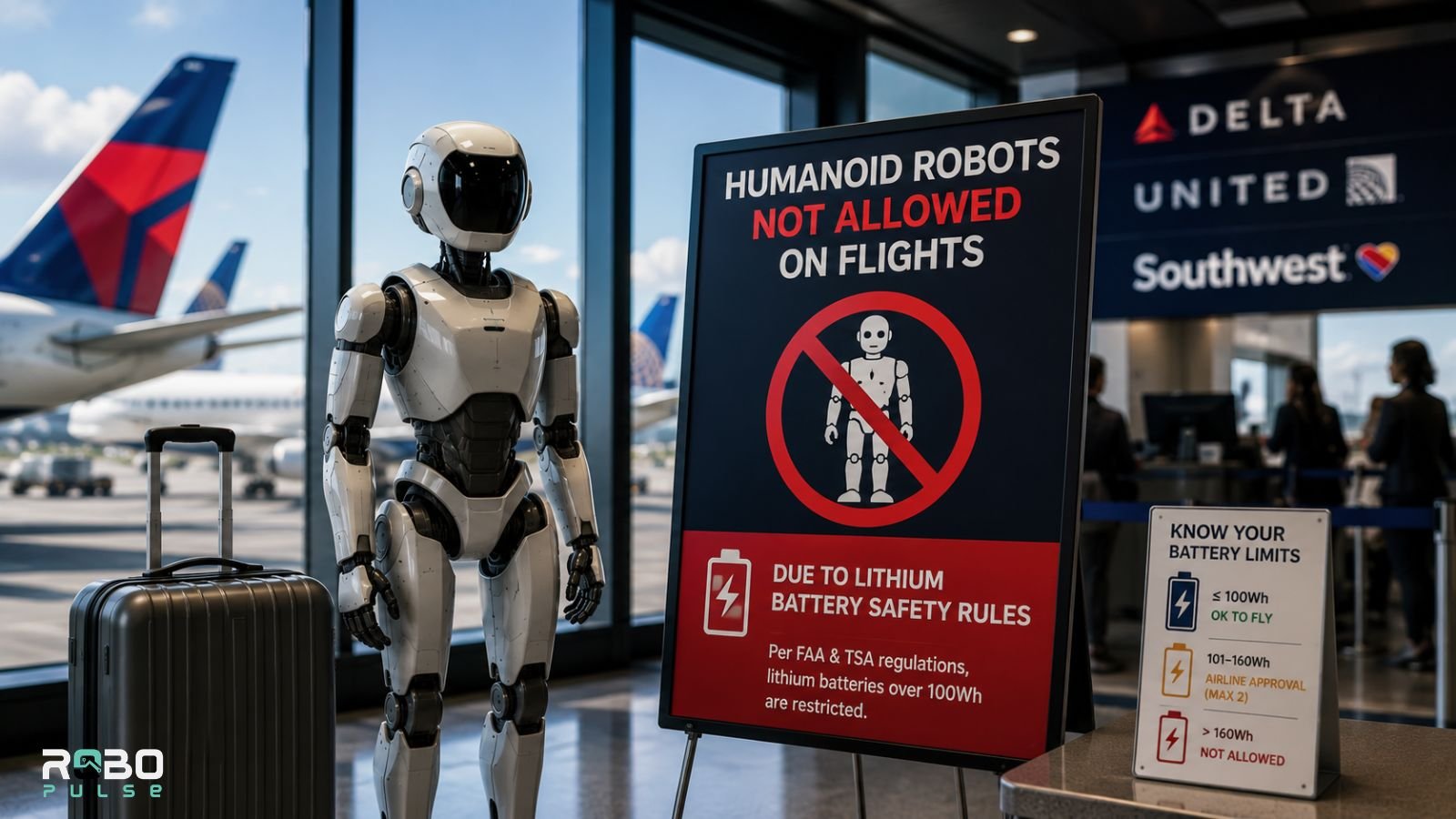
Delta, United, and Southwest now ban humanoid robots from cabins and checked bags. The headlines frame this as airlines getting nervous about robots. Read the actual policies, and the target isn’t the robot at all. It’s the battery inside it.
How the ban started
A passenger boarded a Southwest flight with a robot companion earlier this year. Southwest announced a ban in May, citing battery safety. Delta followed in June. United followed in July, calling its policy proactive rather than a response to any single incident.
United confirmed the real concern directly: these robots run on the same battery chemistries the airline already restricts. Delta’s wording goes further. Its policy targets robotic devices whose lithium batteries cross its watt-hour limits, since those cells carry fire and security risks on board an aircraft.
That detail matters more than the “humanoid” label suggests.
The FAA already wrote this rule. Robots just walked into it.
Airlines didn’t invent a new robot policy. They extended one they already had. The FAA caps carry-on lithium-ion batteries at 100 watt-hours without restriction. Batteries between 101 and 160 Wh need airline approval and get capped at two per passenger. Anything above 160 Wh doesn’t fly, period. TSA enforces the same tiers at security checkpoints.
A humanoid robot built to walk, gesture, and hold a multi-hour charge doesn’t fit inside a phone-sized power budget. It needs a pack that lands in the strictest tier by default, the same tier that already governs oversized power banks and aftermarket laptop batteries.
So the first humanoid robot banned from a plane got banned for the same reason a 180 Wh power bank gets confiscated at TSA. Not because it looks human. Because it draws power like industrial equipment.
The rulebook still has no name for this category
Aviation hazmat manuals don’t have a “robot” classification. They have a battery-capacity classification, and robots get sorted into it by resemblance. That’s a fast fix for a battery problem. It’s not a fix for a robot problem.
A companion robot that walks off a Southwest flight raises a different question than a laptop in a bag ever could: what happens when the machine is active, not just present? None of the current airline policies say whether a robot needs to be powered down completely, whether its joints need to lock, or whether “checked baggage” makes sense for anything capable of moving under its own power. The industry hasn’t settled on a shared definition of what counts as a humanoid robot in the first place, let alone how to classify one mid-flight.
Bipedal movement is the whole point of this category. A walking humanoid has actuators, balance systems, and a power draw a checked-baggage rule was never built to anticipate.
The friction nobody’s solved yet
Northeastern roboticist Ravinder Dahiya told CBS News he supports the bans on safety grounds. He also flagged the cost to researchers, who often need to bring a robot to a demo in person. That tension isn’t going away. Trade shows and industry events like Automate 2026 depend on physical demonstrations, and every one of those now means either shipping a robot as air freight under hazmat rules or driving it.
A quick look at current production humanoids’ battery specs side by side shows why airlines landed here fast: runtime targets across the category push most platforms well past the 100 Wh carry-on threshold before they’ve even left the lab.
Elon Musk keeps predicting humanoid robots will eventually become common outside factories and labs. If that happens, the rules built for battery packs will need a second pass built for machines that walk. Right now, airlines are regulating the battery they can see and hoping the robot around it behaves.