

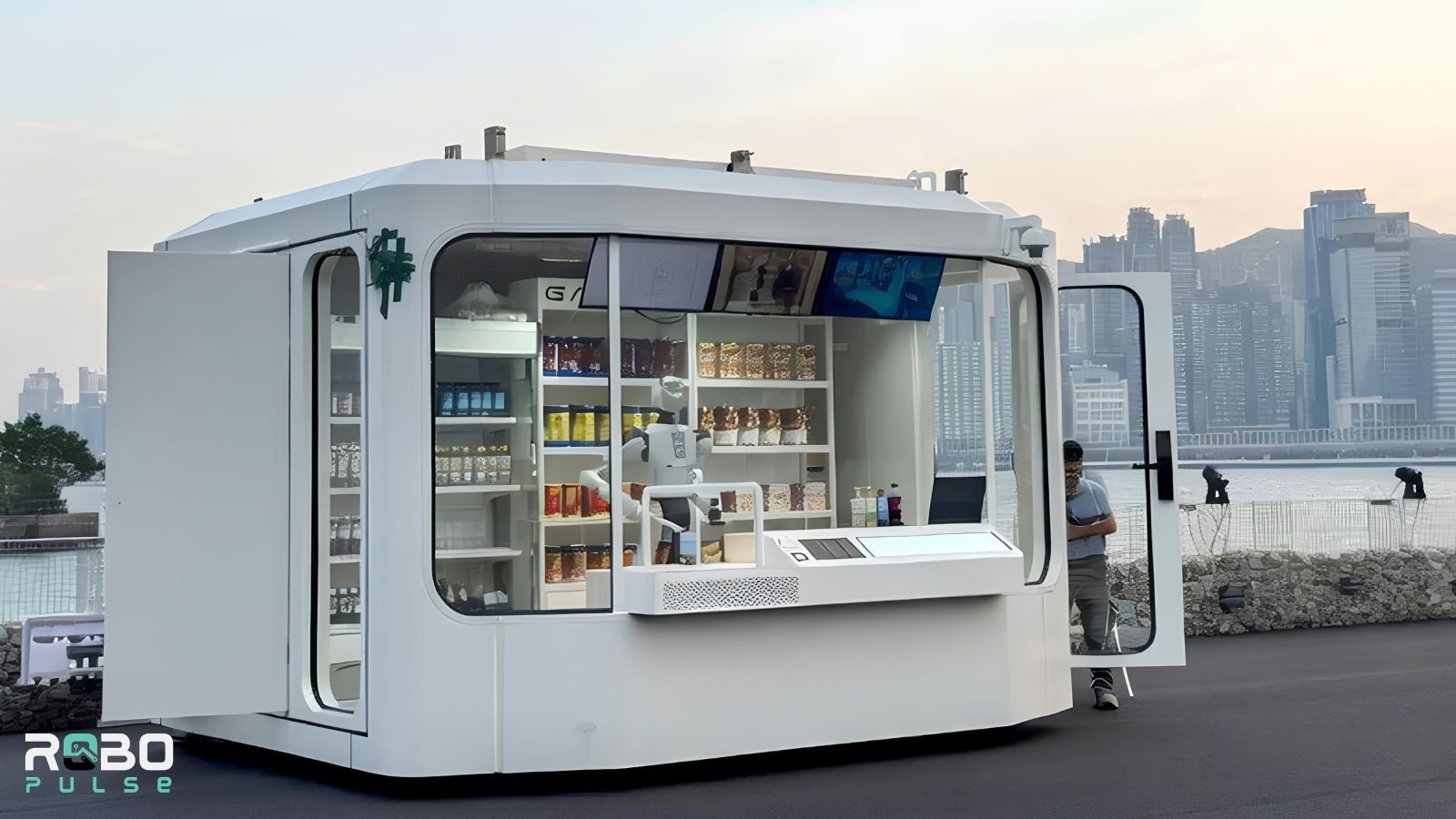
Most coverage of this story led with the novelty. A robot running a store. No humans. Very cool.
What that framing misses is the part that actually matters: Galbot has already done this before, in dozens of cities across China — and now it’s bringing that model to Hong Kong for its first international test.
What’s Actually Happening
A 24-hour convenience store has opened on the Hung Hom waterfront in Hong Kong, and it runs entirely without human staff. The robot handling everything — shelf stocking, product retrieval, customer checkout — is named Xiao Gai, a humanoid developed by Beijing-based AI and robotics company Galbot. The store is packaged in a portable capsule unit and is backed by the Hong Kong Investment Corporation, which is framing it as evidence that AI is moving from demonstrations into daily life.
That framing is accurate — but it undersells what Galbot has already built.
Before this Hong Kong pop-up, Galbot’s autonomous retail stores were already operational in more than 30 cities across mainland China. The company’s flagship G1 robot entered a partnership with FamilyMart in April 2026, running regular shifts at a Beijing Zhongguancun store. It’s been operating in unmanned pharmacies across Beijing, handling medication retrieval and dispensing 24 hours a day. This isn’t Galbot’s first rodeo. Hong Kong is the international audition.
The Robot Behind the Store
Xiao Gai stands roughly five-foot-six, with a six-foot arm span that he uses to reach shelves, retrieve products, and handle transactions. Galbot says the robot supports multi-language conversation and can assist shoppers browsing snacks, drinks, and over-the-counter medicines.
What makes Galbot’s approach technically distinct is the AI stack underneath. The G1 runs on Galbot’s proprietary GroceryVLA and GraspVLA models — purpose-built for retail — which allow the robot to handle around 5,000 different product types without needing to reprogram for each one. In pharmacy trials, the grasping success rate has been reported at approximately 99.5 percent across fragile and irregularly shaped packages. That’s not a lab number — that’s from live operational pharmacy environments in Beijing. If you’re following the broader humanoid robot landscape, that kind of real-world grasping reliability at scale is still genuinely rare among competing platforms.
Galbot is projecting that the novelty factor alone will increase foot traffic around the Hung Hom location by 40 percent. That’s a marketing claim, and it may well hold for the first month. But foot traffic from curiosity and repeat visits from actual convenience are two very different things.
Why This Store Is Actually a Good Test
Here’s what the optimistic coverage glosses over: the capsule format is almost the best-case scenario for a humanoid robot.
The layout is fixed. The product range is limited. The customer journey is predictable. There’s no back-of-house chaos, no complex supplier relationships to manage in real time, no rush hour with 40 people queuing. These constraints don’t make the experiment less interesting — they make it appropriately scoped. Galbot is smart to start here.
The harder variables are what happens outside the script. What does Xiao Gai do when a customer asks for something in Cantonese slang? When a delivery arrives with the wrong items? When the payment terminal misfires at 2 AM with no human to override it? These aren’t edge cases — they’re Tuesday. And they’re exactly the category of problem that the Galbot CEO has acknowledged as the G1’s two biggest remaining challenges: natural voice interaction and operational speed.
Humanoid robots that work beautifully in controlled conditions and then hit friction in unstructured real-world environments are the defining story of the industry right now. The capsule store is designed to minimize that exposure. Whether the model holds when Galbot opens in a busier, messier, more linguistically diverse environment is the question that actually matters.
The Expansion Plan Is the Real Story
Galbot’s CEO, Wen Airong, has publicly stated the company’s intent to roll out 100 robot-managed capsule stores across ten cities. That’s not just ambition — Galbot has raised over $800 million in total funding, was valued at $3 billion as of late 2025, and counts CATL, Bosch, and CITIC among its investors. The money and the partnerships suggest this isn’t vaporware.
The comparison that puts this in context: Amazon’s Just Walk Out technology cost billions and took years before it quietly started pulling back from grocery stores due to the hidden cost of human reviewers verifying checkout decisions. A humanoid robot doing the job physically — rather than relying on camera-based inference — sidesteps that particular failure mode, but it introduces its own. Physical wear, unexpected object handling, and mechanical failure in the middle of a customer interaction. These aren’t hypotheticals; they’re the operational reality that will determine whether 100 stores become 1,000.
The 40 percent foot traffic projection, if it holds past the first few weeks, is actually the metric worth tracking. Not as proof of concept for the technology, but as proof of concept for the business model. Novelty-driven traffic fades. Utility-driven traffic compounds.
What to Watch
Galbot’s Hong Kong expansion is a genuine signal, not a stunt. The company has the technical track record, the capital, and now an international proof of concept in motion. Humanoid robots in service environments are moving from “impressive demo” to “operational question” — and the operational question is always the harder one to answer.
The future of retail may well run without human staff. But it’ll be decided by whether customers return after the novelty disappears — not by whether the robot can stock a shelf.
It can stock the shelf. That part’s settled.
Related: Apollo Robot Review 2026: The Industrial Humanoid Built for Real Work