

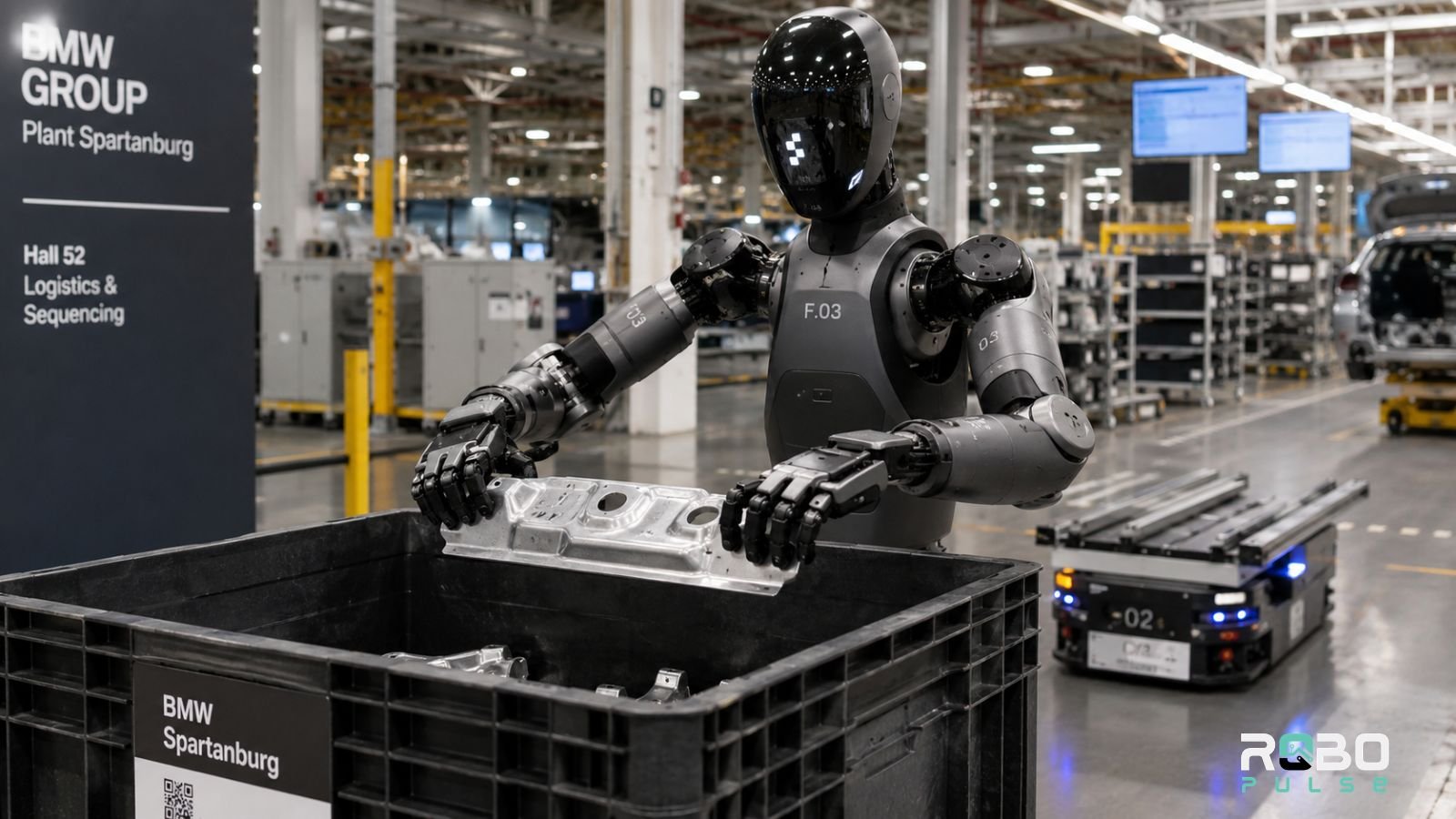
The headline says BMW is testing a new robot.
The real story is that physical AI just crossed from pilot projects into repeatable industrial workflows — and automotive logistics is entering a new phase of automation.
What’s Actually Happening
BMW Group is deploying Figure AI’s Figure 03 humanoid robot at Plant Spartanburg, South Carolina, in a live logistics sequencing role.
Not a demo. Not a controlled trial.
This follows a dual-track collaboration with Figure AI: a ten-month production run where Figure 02 supported the build of more than 30,000 BMW X3 vehicles in the body shop, running inside an eleven-month partnership overall.
That distinction matters. The production clock and the collaboration clock aren’t the same, and how manufacturers measure humanoid performance will shape how the industry funds the next generation of deployments.
What Figure 03 Actually Does
Components arrive at Hall 52 in large containers. Unsorted. In bulk.
Figure 03 picks them up, sorts them into sequencing trolleys, and hands them off for automated transport — either via tugger trains or Smart Transport Robots — directly to the assembly point where workers need them, in exact order.
That’s called just-in-sequence logistics. It sounds simple, but it isn’t.
It demands spatial reasoning, grip consistency, and the ability to handle variable part shapes inside unpredictable container depths. Traditional fixed automation breaks on that kind of variability. If you’ve been tracking the broader humanoid robotics race, you’ll recognize the pattern: manufacturers always start humanoids on unglamorous logistics work — not glamour tasks.
Figure 03 is built for exactly this. New features include:
- Tactile sensors + palm cameras for increased grip precision
- Wireless charging for higher uptime
- Speech-to-speech audio for communication on the floor
- Soft-component frame for safe human co-working
The Angle Nobody’s Writing About
Most outlets are calling this a robotics milestone.
It’s also a workforce protection strategy.
BMW is explicit: humanoids go where work is monotonous, ergonomically punishing, or safety-critical. The sequencing role Figure 03 is taking on is exactly the kind that drives repetitive strain injuries and high turnover in human workers over long production cycles.
These robots aren’t being introduced as general-purpose replacements. They’re being deployed into repetitive, physically demanding roles that manufacturers have historically struggled to staff and sustain over long production cycles.
The Bigger Picture: iFACTORY Is the Real Play
The robot is only one layer.
Hall 52 is running BMW’s full iFACTORY stack — and it’s more ambitious than the press release suggests:
AIQX — AI quality inspection using cameras and acoustic sensors, providing real-time defect feedback to line workers via smart devices. BMW is already exploring making AIQX available to suppliers.
Virtual Factory — 3D simulations that model human movement sequences before anyone takes a position on the line. Ergonomics is optimized in software before it becomes a physical problem.
This isn’t a factory with a robot in it. It’s a fully AI-layered production environment that happens to include a humanoid.
What Happens Next
If AIQX expands to suppliers, Spartanburg’s AI infrastructure could become an industry template — rather than a single-company advantage.
If Figure 03 proves reliable in sequencing operations, BMW gains a repeatable logistics model: humanoid sorting, autonomous transport, and human assembly working as a single system.
The question is no longer whether humanoid robots can function inside automotive manufacturing environments.
BMW’s 30,000-X3 deployment offered one of the clearest demonstrations yet.
The question now is how quickly those lessons spread beyond South Carolina — and how many manufacturers decide they can no longer afford to wait.
Related: Everyone’s Watching Humanoids. The Real Money May Be in Robot Arms