

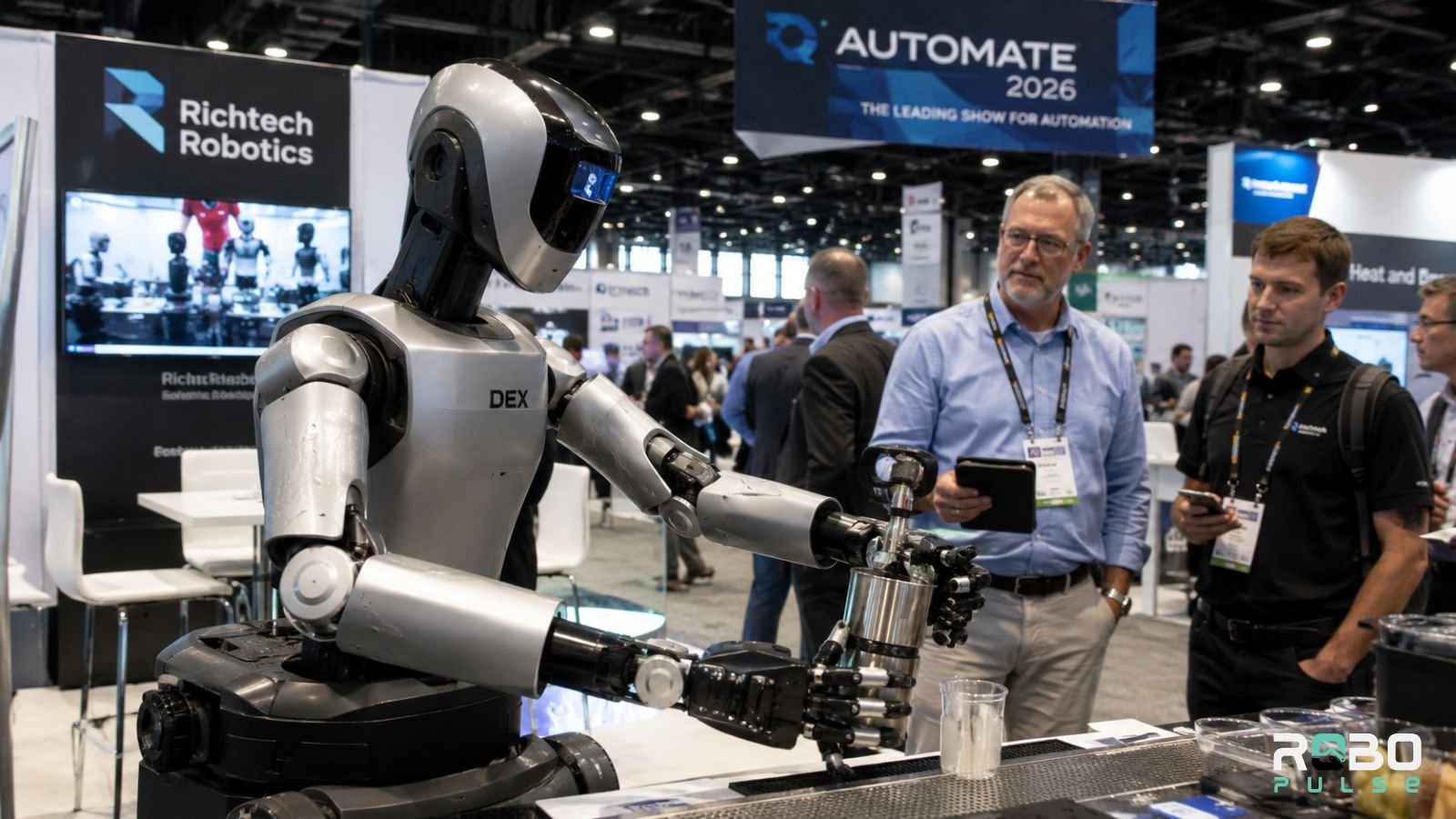
The robots are already mixing drinks.
Soon, they may be folding your laundry.
That is the bigger story emerging from McCormick Place this week, where Automate 2026 is showcasing a new phase of robotics: machines designed not only for factories, but for the messy, unpredictable environments where humans live and work.
North America’s largest robotics and automation event is running June 22–25 in Chicago, bringing together engineers, robotics companies, AI researchers, and the public. This year, the spotlight has shifted heavily toward humanoid systems and physical AI — the idea that artificial intelligence is moving out of screens and into machines that can interact with the real world.
Automate 2026: The New Frontiers of Physical AI
Automate 2026 features its first dedicated Humanoid Robot Pavilion, highlighting how quickly human-shaped robots are moving from research projects toward commercial testing. The industry is splitting between robots designed for immediate efficiency and those chasing human-like mobility — and Chicago is where that split is most visible.
For decades, industrial robots lived behind safety barriers. They welded vehicles, moved parts, and repeated the same action thousands of times.
The next generation is different.
These systems are being built for environments where the rules constantly change. A warehouse is controlled. A hospital hallway is not. A kitchen is even harder. That is why the real test for humanoid robots is not whether they can move — it is whether they can adapt.
The Humanoid Robot Debate: Wheels vs. Legs
One of the most interesting shifts at Automate 2026 is that the future of humanoid robots may not look exactly like science fiction.
Richtech Robotics is demonstrating DEX, a humanoid-style robot designed for commercial environments. Instead of a fully bipedal walking design, DEX uses a wheeled base — a practical engineering decision focused on stability, battery efficiency, and immediate deployment. It’s a design philosophy increasingly common across the industry, and one worth exploring in depth if you want to compare today’s leading humanoid platforms side by side.
That choice represents a larger debate inside robotics: should companies build robots that move exactly like humans, or machines that simply complete useful tasks? Bipedal robots promise flexibility because they can theoretically navigate human spaces. Wheeled robots often win on reliability because they avoid the complexity of balancing and maintaining stability.
The winner may not be the robot that looks most human. It may be the one that works.
Why the Home Is Robotics’ Hardest Challenge
Factories are easy places to automate. The environment is predictable. Objects are placed intentionally. Tasks repeat.
Homes are the opposite.
Every house is different. Objects move constantly. People create unexpected situations every day. A robot that can move boxes in a warehouse is not automatically ready to load a dishwasher.
We are already seeing early signs of this shift in the real world. Humanoid robots are beginning to appear in service environments that would have seemed far-fetched just two years ago — including convenience stores in Hong Kong, where robots are now handling shelf-stocking and customer-facing tasks in live retail settings. That is not a controlled factory floor. That is a human space, with all the chaos that comes with it.
Companies are increasingly using simulation-to-reality training pipelines, where robots learn inside virtual environments before being deployed into the physical world. The goal is simple: teach robots to handle the unpredictability of human spaces before they ever enter one.
Pushing Robots to Their Limits — Literally
The technical ambition on display at Automate 2026 goes beyond service environments. Some developers are stress-testing humanoid mobility in the harshest conditions possible.
Earlier this year, humanoid robots were taken to extreme-altitude environments — including climbs on Pemba, Chimborazo, and Everest — to evaluate how these machines perform under physical stress that no factory simulation can replicate. Cold, thin air, unstable terrain. If a robot can navigate that, a hospital hallway or a home kitchen starts to look manageable.
That kind of real-world testing is accelerating the timeline. What felt like a decade away in 2022 now feels like a product cycle.
The Labor Question Behind Automation
Jeff Burnstein, president of the Association for Advancing Automation, has argued that robots can take over repetitive tasks and allow humans to focus on higher-value work. That argument is already visible in hospitals, warehouses, and service environments, where robots often act as assistants rather than replacements.
But the economic question remains: when does assistance become substitution?
A robot that handles routine work may give employees more time for complex tasks. A robot that becomes cheap and capable enough may also change how many workers a business needs. The technology challenge is quietly becoming a workforce challenge.
Not Every Robot Future Is About Replacement
One of the most important demonstrations at Automate 2026 points in another direction entirely.
The Psyonic Ability Hand, developed by Dr. Aadeel Akhtar’s team, represents a different vision of robotics: machines designed to restore human ability rather than replace human labor. Advanced prosthetics show what happens when robotics is built around people first. The objective is not efficiency — it is independence.
That distinction matters because the future of robotics will likely contain both realities. One side will focus on automation: robots performing tasks humans currently do. The other will focus on augmentation: robots helping humans do more than they could before. If you want to track which humanoid platforms are pursuing which direction, the RoboPulse robot database is a useful reference for specs, use cases, and deployment status across the leading systems.
Chicago Is Showing the Next Phase of Robotics
Automate 2026 is not just a display of impressive machines. It is a preview of the debate that will shape the next decade of AI.
The factory was only the beginning. The next frontier is everywhere humans are — homes, hospitals, workplaces, and apparently mountain summits.
The robots are not coming. They are already here. And Chicago is showing the world what happens next.
Related: Figure 03 Review: The Home Robot We’ve Been Waiting For?