

Wang Xingxing’s humanoids are cheaper, more numerous, and more visible than anyone else’s. They’re also, by the company’s own sales breakdown, barely used for real work yet — and that fact says more about where the humanoid race actually stands than any backflip video does.
The number that undercuts the hype
Unitree shipped more than 5,500 humanoid and quadruped units in 2025, over a quarter of the global market. But according to figures CEO Wang Xingxing shared in his first international interview, only 9% of those sales go to industrial buyers. Commercial venues like retail stores and exhibitions account for another 17%. Universities, research labs, and independent developers absorb the remaining 74%.
That’s the real story hiding inside a company most people know for viral kung-fu routines: the humanoid industry, at this stage, is mostly selling robots to people trying to build better robots. Hardware has outrun the software meant to animate it, and Unitree’s own sales mix is the clearest evidence of that gap on the market today. The same pattern shows up across the sector in a database tracking specs and deployment status for every major humanoid model, where research and developer buyers dominate deployment notes for nearly every entry.
Hardware is winning. Cognition isn’t.
Wang’s core strategy is manufacturing discipline, not AI breakthroughs. Unitree builds the hardest components in-house, especially the actuators that make up roughly half to two-thirds of a humanoid’s cost, then uses scale to keep cutting prices. It’s worked: the flagship G1 dropped from $16,000 to $13,500 in eighteen months, the R1 now sells for under $5,000, and Unitree’s quadruped “robot dogs” have fallen from $45,000 to under $2,000 over six years.
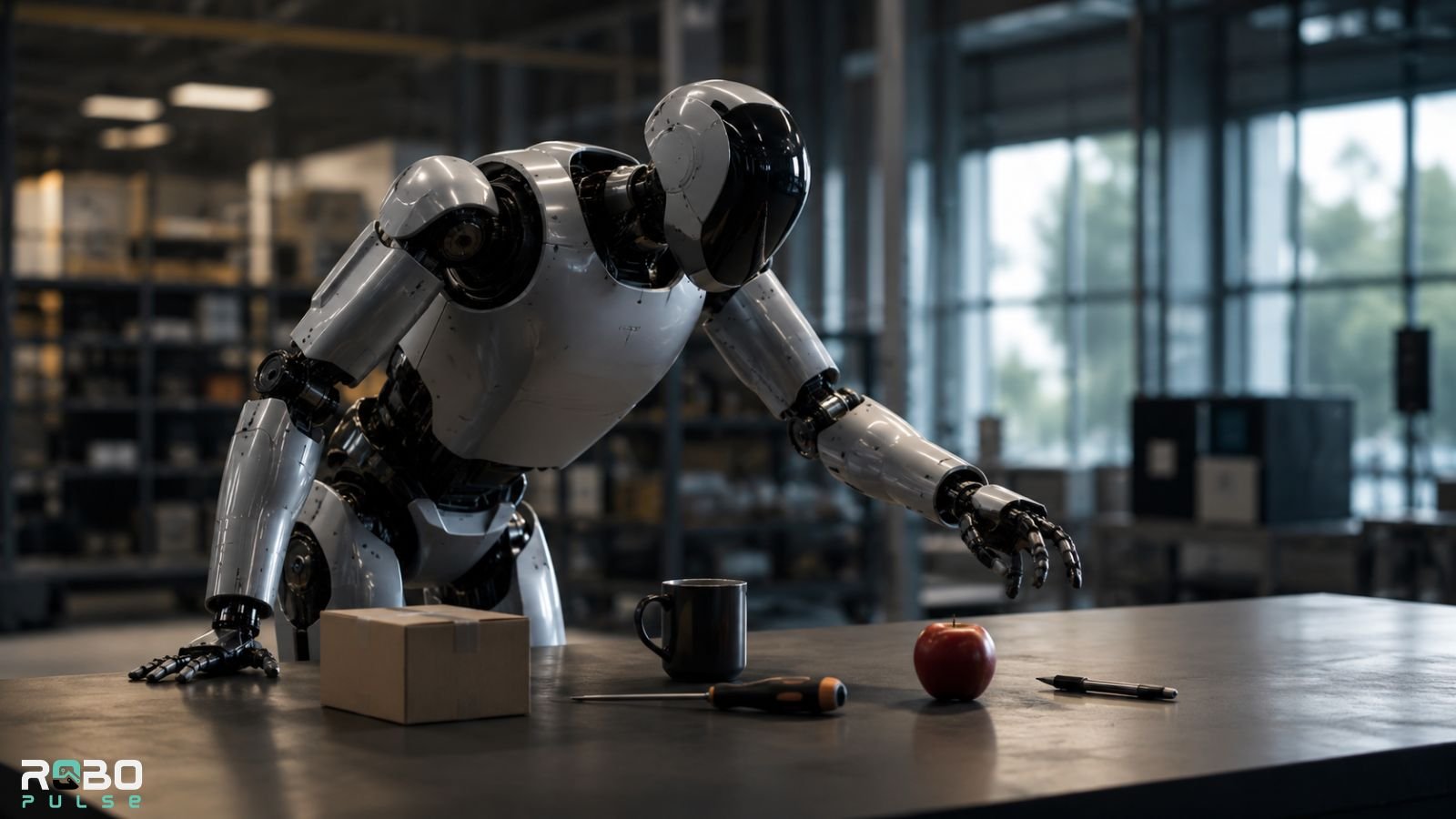
None of that solves what Wang calls the industry’s single biggest problem: the generalization gap. Today’s humanoids remain task-specific machines dressed up as general intelligence. Ask one to move a pen across a desk in a way it wasn’t explicitly trained for, and the illusion breaks.
Even successful training often collapses the moment lighting, object placement, or surface material shifts — a drop-off Noetix CEO Jiang Zheyuan described directly to TIME. The problem traces back to actuator and joint design as much as software — degrees of freedom in a robot’s joints explain why more articulation points don’t automatically translate into more capable movement.
The reason is structural, not just a matter of more compute. Large language models can devour the open internet. Robots can’t train on the internet — they need physical-world manipulation data, collected slowly and expensively, one folded shirt or one stocked shelf at a time. Demand for that kind of granular, hand-level manipulation data is already visible in the market: 1X’s 25-DOF robotic hands sold out at the factory earlier this year, a sign that dexterity, not just walking, is becoming the scarcer resource. That scarcity is also why a New York startup called Micro AGI, a Unitree partner, is reportedly paying staff to clean apartments for free — not for the cleaning, but for the 3D data the cameras capture while they do it.
Why cheap hardware might not be enough
This is where Unitree’s position gets more precarious than the sales figures suggest. Competitors like Tesla, Xiaomi, and XPeng arrive with diversified revenue and existing supply chains behind them. Unitree doesn’t have that cushion.
Tesla in particular looms large here. Elon Musk has repeatedly framed China’s humanoid sector as effectively unrivaled, even as Optimus Gen 3 chases the same generalization milestone from a very different manufacturing base. Wang himself puts it plainly: Unitree’s absolute unit sales remain tiny relative to the market’s eventual size, meaning whoever closes the software gap first — not whoever ships the most units today — could take the lead away from the current volume leader. A side-by-side spec comparison of the two companies’ current lineups makes the size of that gap easy to see.
That’s a very different competitive frame than “China’s robot king,” and it’s the one Wang seems most focused on. He points to 6G connectivity — not incremental AI model upgrades — as the more likely unlock, since near-instantaneous network lag could let lightweight robots run on cloud-based reasoning instead of carrying heavy onboard compute, with a human able to step in remotely the moment a robot gets stuck.
The GD01 is a demo, not a data point
Unitree’s showpiece for this profile was the GD01, a nine-foot, half-ton, pilotable mecha that can walk on two or four legs and retails for $650,000. It draws inspiration from both mixed martial arts and Avatar‘s mech suits, and it sits in a different design category from the walking, task-oriented humanoids that make up most of today’s commercial humanoid types. The mecha is a halo product, not a roadmap toward mass deployment.
The more consequential machine in the room is the humbler one already in warehouses — carrying roughly 5 kg for 10 to 15 minutes without overheating, at 30% to 50% of human efficiency on general tasks. That’s “good enough” for pilot logistics work, per Wang, but it’s not the generalized labor force that $5 trillion market forecasts assume is coming. For context on how that industrial rollout is actually progressing across the sector, coverage of the Automate 2026 trade show tracks which factory deployments are real versus staged demonstrations.
The regulatory shadow
None of this is unfolding in a vacuum. U.S. lawmakers introduced the bipartisan GUARD Act in June, aimed at Chinese robots deemed national-security risks, with Unitree named directly over alleged state subsidies. Beijing, meanwhile, has designated humanoids a “disruptive innovation” on par with EVs and smartphones, backing the sector with city-level investment funds Morgan Stanley estimates at over $26 billion in combined municipal funding since late 2024.
That geopolitical scaffolding matters because it changes what “winning” the generalization race means. It isn’t just a technical milestone anymore — it’s an industrial policy outcome, with export bans and subsidy fights shaping which country’s data, chips, and deployment volume compound first.
The takeaway
Unitree’s real achievement so far isn’t a smarter robot. It’s proving that humanoid hardware can be made cheap and reliable enough to sell in volume before the AI to make it broadly useful even exists. That’s an unusual position for an industry to be in — mass-producing the body before the brain is ready — and it means the next 24 months will likely be decided less by whose robot looks most impressive on stage, and more by whoever accumulates real-world manipulation data fastest.
Related: MIT’s New Artificial Muscles Lift 200× Their Own Weight — And They Don’t Need Motors