

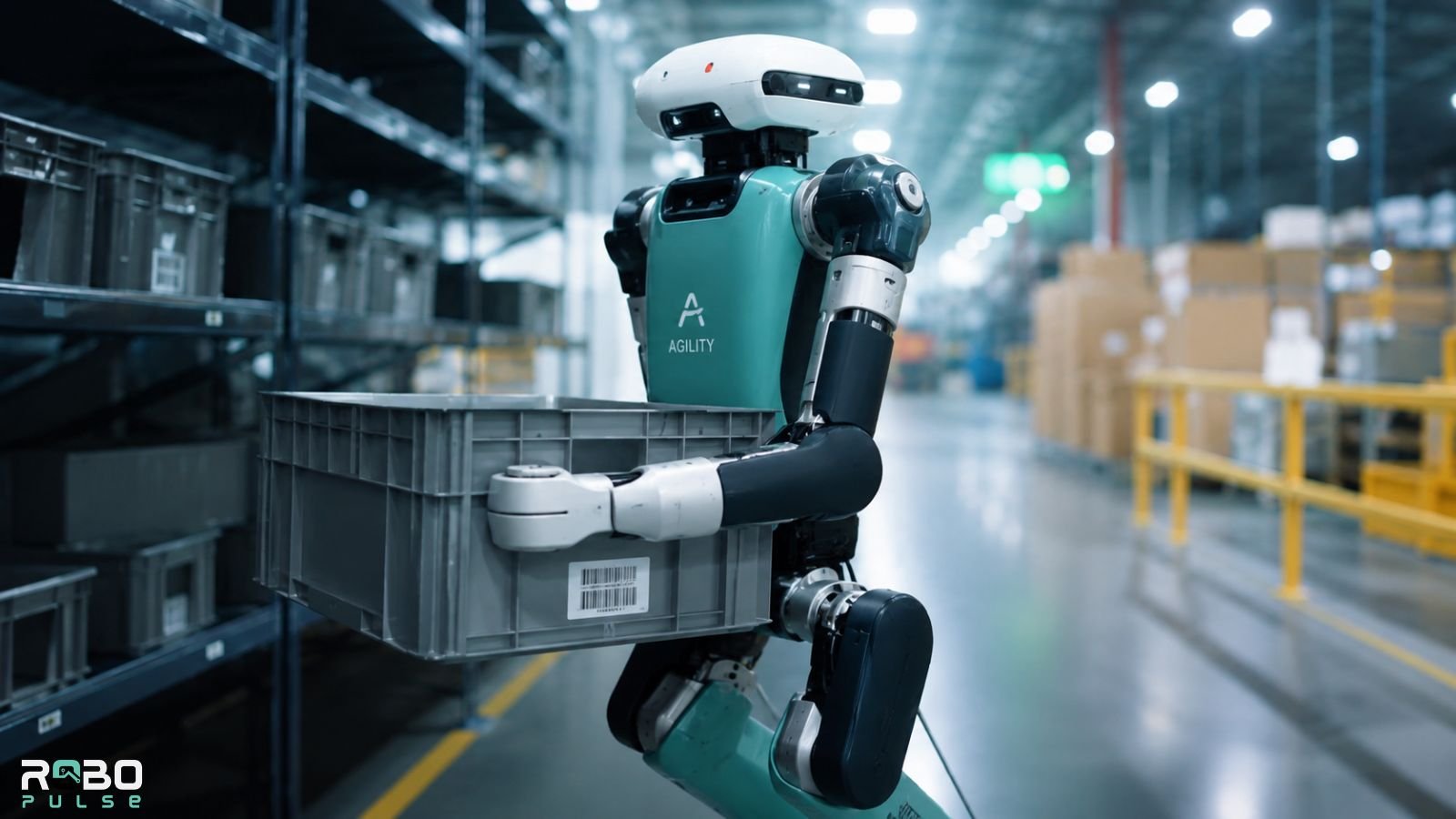
Every other humanoid robotics company right now sells a dream. Agility Robotics sells a spreadsheet.
That contrast drives the real story behind its decision to go public.
Rivals keep chasing valuations that climb past reason. Meanwhile, CEO Peggy Johnson did something almost nobody in this sector does during a recent interview: she refused to promise more than the robot can deliver.
Agility is merging with Michael Klein’s Churchill Capital Corp XI, a SPAC, in a deal that values the company at around $2.5 billion.
The funding matters. But Johnson’s restrained messaging may prove even more significant in the long run.
How Much Is Agility Robotics Raising, and How Does It Compare to Rivals?
The merger should deliver up to roughly $620 million in gross proceeds. That makes it one of the largest financings ever announced for a humanoid robotics company.
The exact ranking depends on how you count private mega-rounds against SPAC proceeds, so treat that claim as directional rather than definitive.
For context: AI2 Robotics recently raised nearly $735 million at almost a $3 billion valuation. Apptronik closed $935 million at more than $5.5 billion. Figure AI reported a $1 billion round at a $39 billion valuation.
Against that backdrop, Agility’s $2.5 billion looks almost modest.
Oregon State University spun the company off in 2015, and it’s based in Salem, Oregon. Agility builds bipedal humanoid robots for warehouses and factories — the kind of deployment environment Automate 2026 highlighted as ground zero for the current wave of factory automation.
If the deal closes, Agility becomes the first publicly traded pure-play humanoid robotics company. That could give retail investors direct exposure to the sector for the first time.
Johnson pointed to more than $300 million in contracted multi-year commitments. Those commitments tie to roughly 1,000 robots running on a robots-as-a-service model.
Customers reportedly include GXO Logistics, Amazon, Toyota Motor Manufacturing Canada, Schaeffler, and Mercado Libre. These numbers come from Johnson’s own comments, not yet from an SEC filing, so expect firmer figures once the deal formally proceeds.
Why Is Agility’s CEO Avoiding Hype in Robotics?
Most coverage of this deal misses a key detail: Agility’s pitch is deliberately conservative. That restraint is exactly why it might work.
Johnson spent years as a Microsoft executive, where she helped engineer the $26 billion LinkedIn acquisition. She later ran Magic Leap — a company that became a cautionary tale about hype outrunning hardware.
That history seems to shape how she’s handling this moment. She wouldn’t give forward-looking financial guidance. She wouldn’t disclose Digit’s bill of materials.
Instead, she kept redirecting the conversation toward deployment numbers, contracted customers, and safety certification.
Compare that to industry norms. Robotics demos get choreographed. Funding rounds arrive with breathless valuation math.
Figure AI knows this pressure well. The company has faced internal legal disputes over product safety allegations, which it denies — disputes that sit oddly alongside the polish of its Figure 03 launch.
Agility, by contrast, has quietly done the unglamorous work. It secured the industrial safety certifications required to operate inside customer facilities, rather than retrofitting safety after the fact.
Johnson put it simply: safety gets certified from the electrical system up. You don’t bolt it on after building the robot.
Are Better Language Models Making Humanoid Robots Better?
Johnson made a sharper point buried in her comments about AI itself. Agility stays “LLM-agnostic,” pulling on models including Claude and Gemini for the semantic layer that turns instructions into robot behavior.
But she drew a clear line: language models aren’t the hard part anymore.
The internet handed LLMs an enormous training set. Physical AI — the kind that governs balance, grip, and multi-jointed movement — doesn’t yet exist at most companies in any comparable form.
That’s a quiet but real correction to a popular narrative. Better chatbots don’t automatically produce better robots.
Locomotion and manipulation depend on degrees of freedom and bipedal balance systems that take years of real-world deployment data to refine — not internet-scale text.
This gap also explains why some markets have leaned on rental and short-term deployment models instead of full autonomy: China’s humanoid rental boom runs into the same physical AI ceiling Johnson describes.
Agility has spent over a decade grinding on exactly that problem.
When Will Humanoid Robots Be Ready for Homes?
The home-robot fantasy isn’t dying here. It’s just getting pushed honestly out of frame.
Johnson said humanoids will eventually reach the home — but not for “10-plus years.”
Warehouses offer fixed aisles and predictable layouts. Homes don’t. They’re chaotic, full of pets, kids, guests, and clutter.
She compared it to self-driving cars. Even roads have some structure. Most home environments don’t offer humanoids that same baseline.
What Does the Agility Robotics IPO Mean for Investors?
For investors, that timeline reads as either a red flag or the entire point — depending on your appetite for patience.
A company that won’t promise a general-purpose household assistant by 2028 isn’t setting itself up to disappoint you by 2028.
For the industry, Agility’s IPO sets a real benchmark. It gives outsiders a rare, transparent look at the finances of a humanoid robotics business, in a sector where most competitors guard their numbers closely.
If Agility trades well, expect more humanoid companies to follow this path instead of chasing another private mega-round.
If it stumbles, expect comparisons to 2021’s SPAC flameouts to write themselves. Johnson seems aware of that risk — she keeps framing execution and steady delivery as what separates Agility from that earlier volatility.
Warehouses currently carry over a million unfilled, physically demanding jobs in the U.S. That’s the real market Agility builds for. Not your kitchen.
Closing Line: The company making the fewest promises right now might be the one worth watching the most.
Related: Synthetic Humanoids Explained: Can Artificial Muscles Beat Traditional Robots?